|
Field meetings programme for this year and examples from previous years
Please come and support the society meetings.
Trips are free of charge to all GSN members (select 'GSN member ticket' on Eventbrite).
Non-members will be required to pay a 5 cash supplement on arrival at the field trip.
We strongly recommend that anyone who isn't a member and likes the look of the fieldtrips to sign up to the GSN for
future free access to all field trips and lectures. As always, field trips are only ever put in place by other GSN members
kindly giving up their free time to help us out. If you think a particular area of Norfolk deserves a visit by the GSN
and feel confident enough to lead a trip or know somebody that would, please let us know.
It is vital that you register your interest with Clare Horne for all field meetings (contact details below). To do this and to receive full details of the field trip and joining instructions (including address, timings and more information about the content of the trips) please use the 'Eventbrite' online ticket system. The link to the appropriate Eventbrite page for each field trip is provided below. If you would like to attend a field trip, please follow the appropriate link and sign yourself up so that we can keep track of numbers. If anybody is finding the system difficult to use, do not hesitate to email Clare and she will help you or provide an alternative method. Details of these field trips will also be posted on the GSN Facebook page at: https://www.facebook.com/pages/Geological-Society-of-Norfolk/160211420712550).
Clare Horne
Email: clareh917@gmail.com
Mobile: 07730 581363
Fieldtrips for the summer/autumn 2023 season:
Tuesday 4th July: 10.30am 1pm.
Geodiversity Earth Heritage Walk on Mousehold Heath, Norwich.
Join Geologist Tim Holt-Wilson to explore the Earth Heritage Trail. Experience how past glacial activity and land use has shaped the landscape and how this supports biodiversity.
Meeting at 10:30 at the car park at the northern end of Gurney Road (on its western side), at Mousehold Heath, Norwich. Grid ref: TG247104.
No registration needed just turn up!
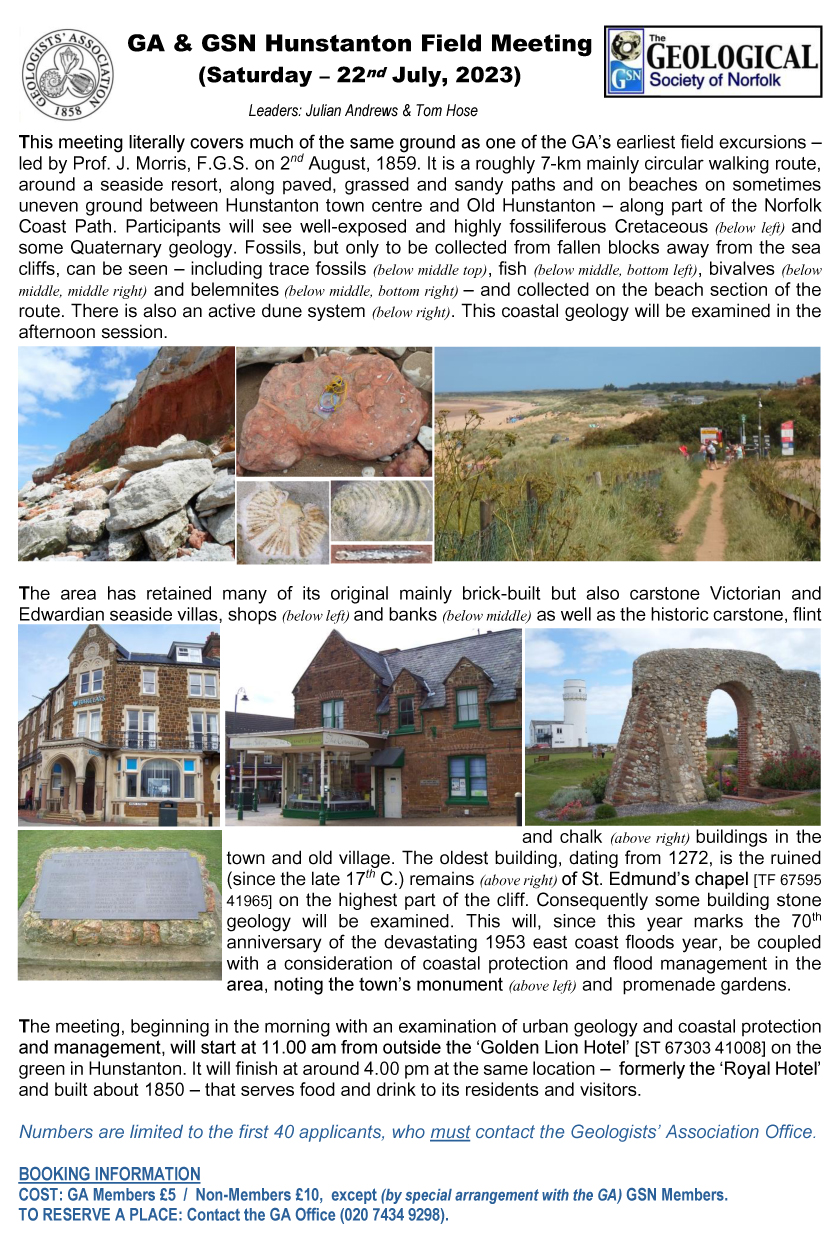
Saturday 22nd July:
Hunstanton field meeting - see poster below.
Saturday 3rd June:
The stones of Dunwich - see poster below.
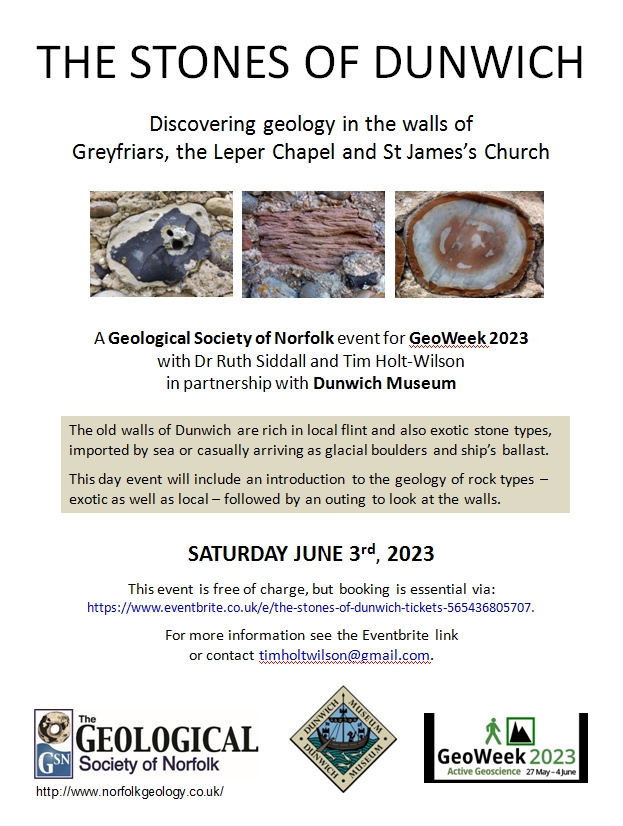 The live booking link for 'The Stones of Dunwich' is below. Tickets are available to members now, and the event will be publicised more widely nearer the time.
Non-members are welcome to attend in return for a donation.
The live booking link for 'The Stones of Dunwich' is below. Tickets are available to members now, and the event will be publicised more widely nearer the time.
Non-members are welcome to attend in return for a donation.
https://www.eventbrite.co.uk/e/the-stones-of-dunwich-tickets-565436805707
Field meetings were cancelled for 2020 and for much of 2021 during the covid pandemic but as of August 2021 they are going ahead.
However, please take appropriate measures to protect yourself and others. Please also note that some of these events are not organised by the GSN but GSN members are very welcome to attend.
Talks at Norwich Cathedral as part of the 'Dippy on Tour' event:
At 7pm on 31st August 2021: The Dinosaurs Rediscovered - a talk by Professor Mike Benton FRS
This talk will illustrate how science has replaced speculation and how our understanding of dinosaurs and their world has completely changed over the last twenty years. New technologies have revealed secrets locked in the bones in a way nobody predicted we can now work out the colour of dinosaurs, their bite forces, speeds and parental care as well as how they came to die out.
Mike is a natural communicator. He is Professor of Vertebrate Palaeontology and head of the Palaeobiology Research Group at the University of Bristol, which was identified by the Center for World University Rankings as the top palaeontology research group in the world. He has written more than fifty books, including the standard textbooks in palaeontology and When Life Nearly Died.
The lecture will be a ticketed event (unassigned seating) and you will need to obtain a ticket if you wish to attend. Tickets will be free for GSN members but 5 for non-members.
Each GSN member will be entitled to one free ticket for their own use and this can be obtained using the website link below.
https://www.eventbrite.co.uk/e/gsn-cathedral-tickets-162305645555
Non-GSN members will need to book via the Cathedral website
https://dippy.cathedral.org.uk/dippy-events/the-dinosaurs-rediscovered
Because of the ongoing Covid regulations, the audience size is limited but hopefully it will be expanded if the regulations change.
The full programme of lectures associated with "Dippy in the Cathedral" can be seen on the Dippy website (link below),
including talks by David Waterhouse on The Deep History Coast, Ben Garrod on 'Who was Dippy?' and Douglas Palmer on 'The Reverend Adam Sedgwick Saint or Sinner'?:
https://dippy.cathedral.org.uk/dippy-events
Fieldtrips for the summer/autumn 2021 season:
GEOLOGICAL WORK PARTY - Tuesday 14th September, 2pm to 5pm.
After the resounding success of the 2018 and 2019 events, we are following up with a post-Lockdown geoconservation session,
restoring the geological exposures which have crumbled and vegetated over the past two years.
This is a joint event supported by the Mousehold Heath volunteers and is being organised by Tim Holt Wilson of the GSN and Will Stewart,
the Heath Warden for Norwich City Council. We will meet at Mousehold Heath car park (Gurney Road, NR1 4HW) at 2pm and aim to finish at 5pm.
Will Stewart will be providing some tools/equipment. However, we would appreciate it if attendees could bring some of their own tools (e.g. mattock, spade, pick, bucket, trowel, secateurs etc). Regardless, would all attendees please bring the following:
Outdoor clothing
Tough footwear
Head/eye protection
Insect repellent
Work gloves
Refreshments
For more information about the Earth heritage Trail and the sites we will be visiting, please go to:
https://www.norwich.gov.uk/downloads/download/2055/mousehold_heath_earth_heritage_trail
A Trail leaflet will also be available on the day.
GUIDED WALK OF THE MOUSEHOLD HEATH EARTH HERITAGE TRAIL - Friday 17th September, 10:30am to 1pm.
This walk, which will be led by Tim Holt Wilson and Will Stewart, forms part of the Norfolk Heritage Open Days.
[General information on all the events going on across Norfolk is available at: https://norfolkheritageopendays.co.uk/ ]
To find out more about the guided walk and to book your place, please visit:
https://norfolkheritageopendays.co.uk/events/mousehold-heath-geology-and-landscape-walk21?start_time=2021-09-17T10.30
Should you have any queries about either event, please contact the organiser Tim Holt Wilson directly at: timholtwilson@myphone.coop
UPON THIS ROCK Tim Holt-Wilson is organising a series of 'day schools' in Norfolk called 'Upon This Rock'.
These excursions taking place over the next few months will examine the geology and architecture of churches in the Broads. For more information see this website:
https://watermillsandmarshes.org.uk/events/upon-this-rock-the-geology-of-broadland-churches-1-acle/
Dates and locations:
Sat 21st August (Yare north area).
Sat 25th Sept (Yare south area).
Sat 23rd Oct (Waveney area).
Four or five churches will be visited at each event, looking at the geology of church fabrics and the architectural use of geological materials. The events are part of the Water, Mills & Marshes landscape partnership programme.
For more information and booking go to the website: https://watermillsandmarshes.org.uk/events/
Should you have any queries please contact the organiser, Tim Holt-Wilson, at timholtwilson@myphone.coop
Fieldtrips for the 2019 season (some field meeting dates and locations are to be confirmed):
GSN FIELD TRIP TO EXAMINE THE LOWER CRETACEOUS OF WEST NORFOLK - 7th September 2019, 9am - 3pm.
The original date for this was Saturday 27 July 2019 but the trip was postponed due to bad weather
The sites to be visited are:
- George's Pit, Middleton a geological SSSI (Blackborough End) with Leziate Beds (Sandringham Formation) below Carstone; featured in GSN Bulletin no.66.
- Mintlyn Quarry, Leziate type site of the Leziate Beds of the Sandringham Formation.
- St Lawrence's Church, Castle Rising use of enigmatic 'silver carr' Pleistocene silcrete in the walls.
- Dersingham Bog a NNR and SSSI with periglaciated scarp landform and bog area with notable iron-pan sediments; featured in GSN Bulletins no. 62 & 67.
- Snettisham Common Pit a County Geodiversity Site with Sandringham Formation below Dersingham Formation; interesting micro-tectonic structures.
- Lodge Hill, Snettisham scarp landform with panoramic views and a small Carstone quarry.
Leaders: Julian Andrews , Tim Holt-Wilson & Peter Riches
For more information and to register for the trip, please go to the following site: https://www.eventbrite.co.uk/e/the-early-cretaceous-in-west-norfolk-tickets-63654073046
Fieldtrips in previous years:
Fieldtrips 2018 season: Some field meeting dates and locations to be confirmed.
September 15th 2018: Glacial geology of Mundesley Cliffs: tills, glacitectonics and debris flows
To book, see this page: https://www.eventbrite.co.uk/e/glacial-geology-of-mundesley-cliffs-tills-glacitectonics-and-debris-flows-tickets-46948268535
Details: This trip is kindly being organised and lead by this years' President, Jonathan Lee of the BGS.
We will be taking a trip to visit an area of the Norfolk coastline between Mundesley and Little Marl Point, Trimingham. We are looking to take in and observe the contrast between the complex glaciotectonics to the north and the layer-cake glacial successions present to the south.
This trip should contain something for everyone to get their teeth into! We will be looking at a variety of sections from chalk rafts; the Crag and both undeformed/deformed glacial successions.
We will meet at the Beach Road car park in Mundesley (NR11 8BQ) at 1pm before walking down to the beach from there. We will then head north along the coastline to Little Marl Point, near Triminghan (approximately 2km each way). There is a cafe and public toilets near the car park in Mundesley if needed. We anticipate the trip will last for approximately 3 hours. Following the event, we warmly invite you to join us at the Ship Inn for a well-earned post-trip pint!
Please be aware that some areas of the cliff in this area are unstable. Hard hats are advisable for all attendees and we will strongly urge participants to stay away from any areas of overhanging cliff.
This trip is free for all members of the GSN to attend. Non-members will be asked to pay a contribution of 5 to the society. Alternatively, you can become a member of the GSN for 10 for the year. This will provide full access to all lectures/trips over the coming year.
Events in 2017:
2nd July 2017. Breckland.
Organised and led by Tim Holt-Wilson.
This trip takes us right to the southern border of the county, an area we do not often venture into! The Brecks (Breckland) area of Norfolk & Suffolk has many sites with fascinating Pleistocene and Holocene geology and has overlapping biodiversity and Palaeolithic interest. This field trip will take in some of the 18 sites featured on the new Brecks Earth Heritage Trail (funded by the Heritage Lottery Fund via the Breaking New Ground landscape partnership). It will include a visit to the British Museum s Palaeolithic excavation at Barnham, courtesy of Dr Nick Ashton.
The trip will be held on 2nd July 2017. We will meet near Knettishall heath at 09:45 and visit sites on Knettishall Heath (Pleistocene features), the British Museum Palaeolithic excavation, Brandon Park (Holocene Dunes) and Session heath (Flint mining pits). Given the number of sites we will visit, participants should be prepared for approximately four miles of walking throughout the day.
Please book with Eventbrite, using this link: https://www.eventbrite.co.uk/e/the-brecks-earth-heritage-trail-gsn-fieldtrip-tickets-34329057134
If you experience any issues with the Eventbrite system, please do not hesitate to contact Lewis Elmes,
the GSN Field Secretary, by email:lewise2u@hotmail.com
Saturday 10th June 2017. Norfolk's most famous section of coastline, Happisburgh to Ostend.
Organised and led by Martin Warren.
We will begin in Happisburgh and walk north towards Ostend to view the classic Happisburgh Till and various other sections along the way. We will meet at the car park in Happisburgh at 13:30 (or 12:30 in the Hill House if you'd like to join us for a pint beforehand) and walk from there.
For full details and to sign up, please book with Eventbrite using this link:
https://www.eventbrite.co.uk/e/the-happisburgh-coastline-tickets-34832924214
Events in 2016:
Field visit to sites along the line of the new Norwich Northern Distributor Road on 24 September 2016, kindly led by Martyn Bumstead of Norfolk County Council with assistance from Balfour Beatty.
Visit to the Headquarters of the British Geological Survey at Keyworth, near Nottingham, held on 5 July 2016.
Coastal Erosion in Norfolk, 25th June.
This will be led by Peter Riches and David Stannard. They will take us between Winterton and Eccles examining the history of
coastal erosion in Norfolk and exploring William Smith's attempts to defend the coastline by 'repairing' sand dunes.
The Impacts of the 2013/14 Storm Surge
28th May 2016.
This trip is being led by Professor Julian Andrews who will take us along the shingle ridge between Cley and Salthouse
to investigate the impacts of the 2013/14 storm surge on the area.
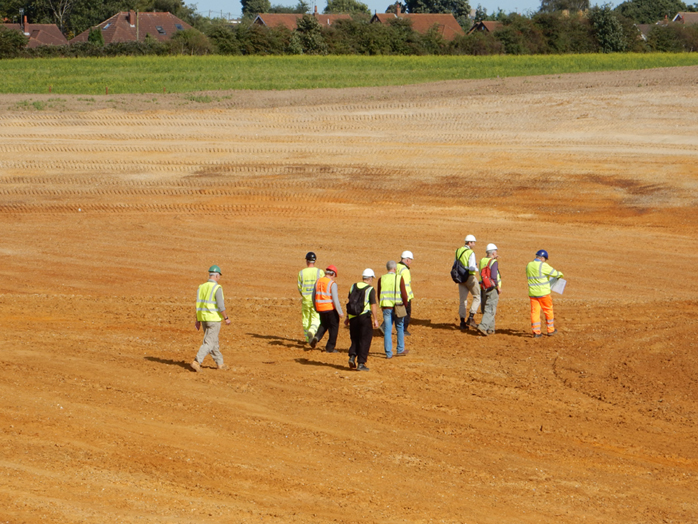
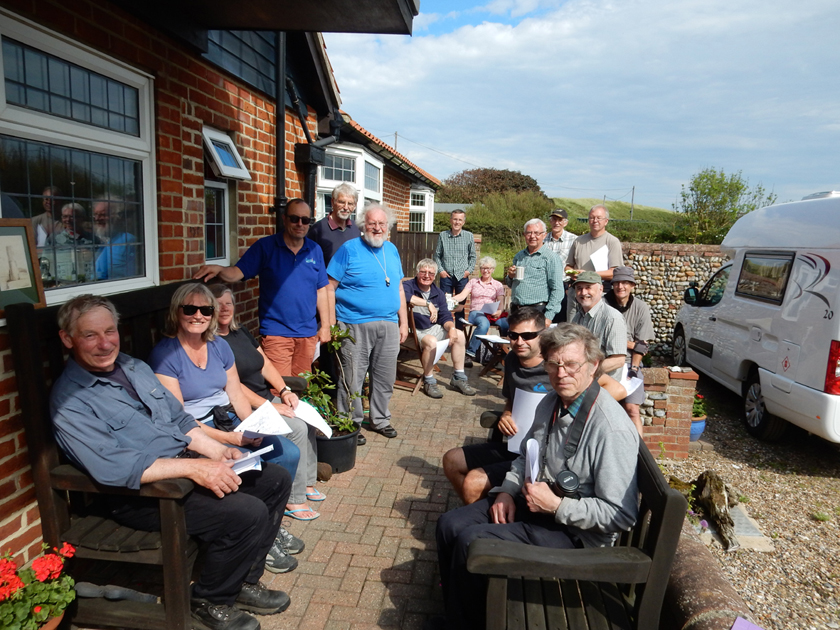
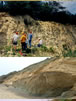
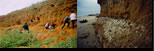
Above left: GSN members attending a field visit to view works associated with the construction of the new Norwich Northern Distributor Road in September 2016. Above right: GSN members relaxing in the garden of co-leader David Stannard's home at Eccles-on-Sea after a field visit to the coast of north east Norfolk in June 2016 to view local sites where William Smith undertook coastal defence and drainage works.
Events in 2015
Field Trip (23rd May) and Microscopy Day School (6th June)
We have a pre-eminent researcher Professor Andy Gale coming all the way from Portsmouth to lead the Microscopy Day School.
Andy is a lively and engaging character and he will make the day fun even if you are not a Chalk specialist.
There is more in this familiar white rock than most people realise and here is your chance to take a closer look with a real expert.
Signing up online is very easy (see below).
If you can, come to the field day to the south of Norwich with Tim Holt-Wilson when the material will be collected and then,
after preparation at the UEA labs you can see what it reveals under the microscope. You don t have to come to both days but it makes sense if you can.
The Chalk of Norwich is one of the classic areas for Upper Cretaceous research. This Field Trip and Microscopy Day School event will introduce participants
to the geology and palaeontology of two important Chalk sites in the Norwich area. Sediment samples will be collected and then processed ready for
microscopic examination of their fossil content.
The event will take place on two separate days and is FREE to all Geological Society of Norfolk (GSN) members.
Non-members will be asked to pay a small fee ( 5 for each day) to attend.
Saturday May 23rd
Field trip led by Tim Holt-Wilson (GSN) at which participants will investigate two classic sites for the Chalk of Norwich.
Sediment samples will be collected for later processing for their fossil content by Dr Jenni Turner (UEA) and Lewis Elmes (GSN) at the UEA laboratories.
Meet at the car park on Colney Lane, Cringleford at 14:00. See map on the Eventbrite website below for further details.
Saturday 6th June - Day School led by Professor Andy Gale (Portsmouth University) at the UEA Environmental Science Laboratories,
at which participants will learn to identify Chalk macro- and mesofossils under Andy s expert tuition, using processed material from the field trip
and the help of microscopes and palaeontological resources.
Meet in the UEA main car park (at the Token pay machines) at 9.45. We will walk down to the laboratory en-masse at 10.00am to allow for late-comers.
This innovative event will provide a special opportunity to boost participants Chalk palaeontology skills, will inform ongoing research into the Chalk
of Norwich by Prof Andy Gale, and will support efforts by the Norfolk Geodiversity Sites Group to protect sites of geoconservation importance in the county.
The event is likely to finish around 13:00.
and register your interest. You will need to book each of these events separately with website if you wish to come to both events.
If you have any queries regarding the event, please contact GSN Field Secretary, Lewis Elmes on lewise2u@hotmail.com.
Places are limited to 30, so please do not delay in signing up.
Events in 2014
Wednesday 22 October 2014, at 15.30
Urban Geology Quiz Crawl
Black Horse public house, 50 Earlham Road, Norwich (not far from
Norwich Cathedral).
A short walk into Norwich city centre to explore the geology of its building
stones. Arrange yourselves in teams of 2-3 and
see if you can score maximum points using your geological skills; or just
come along and see what geological variety the
city of Norwich has to offer. Add beer at regular intervals of course, for
maximum enjoyment.
Saturday 1 November 2014, from 0920 to 1600
Cromer Ridge and East Runton: outwash, glaciotectonics and volcaniclastics
This trip will take you on a tour to view two contrasting exposures: firstly
to Briton's Lane Quarry on Norfolk's own 'mountain', the Cromer Ridge, then
to the coast to view the glaciotectonics of Wood Hill and the rock armour of
imported volcaniclastic rocks.
Field meetings programme for 2013
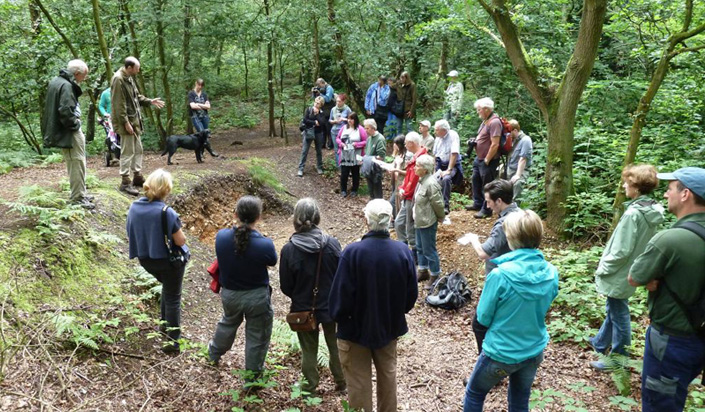 Image to right: Tim giving a guided tour of Mousehold Heath (Photo: Martin Warren) Image to right: Tim giving a guided tour of Mousehold Heath (Photo: Martin Warren)
Saturday 27th April 2013
Mousehold Heath Earth Heritage Trail
Tim Holt-Wilson
A field meeting on Mousehold Heath just as spring is getting underway. Glacial deposits,
Paleolithic archaeology, industrial archaeology and environmental conservation, Mousehold has
it all. Associated with the lecture on 14th March.
Information on the trail can be found
at http://www.norwich.gov.uk/Environment/ParksAndOpenSpaces/WoodlandsHeathsAndMarsh
es/MouseholdHeathTrail/Pages/TrailMap.aspx
Sunday 2nd June 2013
The depositional environments of the Westleton Beds
Howard Mottram
The character, composition and depositional environment of gravelly sands at the top of the
Norwich Crag "Westleton Beds" will be examined in coastal and inland sections in northeast
Suffolk. The different depositional models presented for the gravels will be assessed as well as
their relationship to the Norwich Crag.
Useful references
Hey, R.W., 1967. The Westleton Beds reconsidered. Proceedings of the Geologists
Association 78, 427-445.
Mathers, S.J. and Zalasiewicz, J.A., 1996. A gravel beach-rip channel system: the Westleton
Beds (Pleistocene) of Suffolk, England Proceedings of the Geologists Association, 107, 57-67.
Mottram, H.B., 1997. The channel gravels of the Dunwich and Minsmere cliffs. Transactions of
the Suffolk Naturalists Society, 25, 77 80.
Mottram, H.B., 2012. The Norwich Crag Geology of the country around Westleton. In: Dixon,
R.G., (ed.) A celebration of Suffolk Geology: GeoSuffolk 10th Anniversary Volume. GeoSuffolk,
Ipswich. Pp. 251 258.
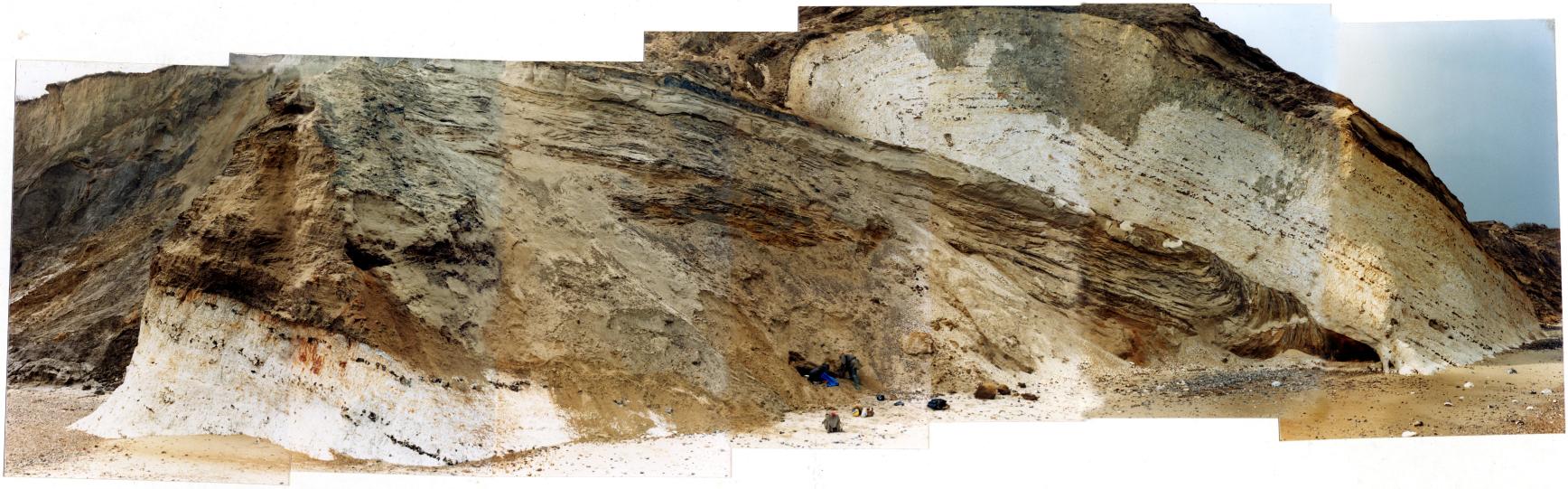 Image to right: Ice-rafted erratics of chalk at Sidestrand (Photo: Martin Warren) Image to right: Ice-rafted erratics of chalk at Sidestrand (Photo: Martin Warren)
Sunday 23rd June 2013
Trimingham Sidestrand section
Martin Warren
This is a fabulous section through rapidly eroding cliffs and contains dramatic structures and
key stratigraphical markers for the understanding of the timing of the Anglian and the structure
of the Cromer Ridge. It is also a good beach for collecting.
Sunday 21st July 2013
Rock Forensics
Jenni Turner and others
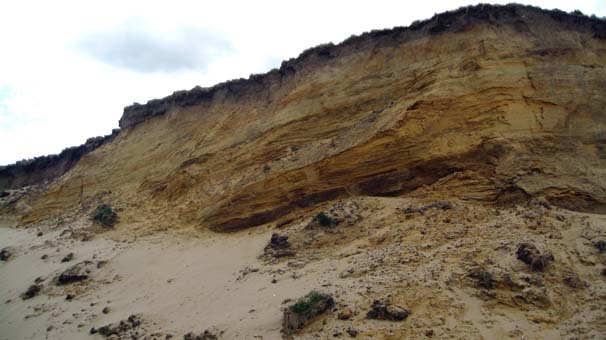 Image to right: Happisburgh cliffs Image to right: Happisburgh cliffs
An introduction to the skills for observing, recording and interpreting the sediments revealed
(possibly) a Happisburgh. This is the
stuff of field geology. Come and improve your skills or share your expertise with other members.
Further field meetings may be announced when details are finalised.
Examples of previous Field meetings programmes: 2011
16th July: The Chalk of North Norfolk with Rory Mortimore
Professor Rory Mortimore followed up on his lecture into the Society in February with a trip to North Norfolk Chalk exposure. The trip visited Wells Chalk Pit, Weybourne Hope, West Runton and finished at Overstrand/Sidestrand. Members from the Geological Society of Norfolk, the Geological Association and the East Herts Geology Club enjoyed a day discussing the Chalk, its features and fossils. Rory spoke with knowledgeable ease and good humour, but to say it rained a lot would be an understatement. At Wells Pit we examined the marl bands in the Newhaven Chalk Formation. This marl is considered to be of volcanic origin. Both the micro and macro fauna differs either side of these bands. Martin Warren found a good example of the bivalve Sphenoceramus (Inoceramus) lingua.
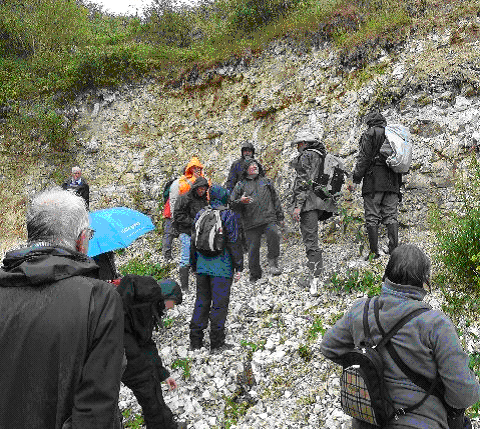 In Wells Pit (Photo: Russell Yeomans) In Wells Pit (Photo: Russell Yeomans)
At Weybourne Chalk cliffs to the East of the car park we examined the flint bands and discussed differences in flint shapes and looked at Pleistocene sediments weathering down through chalk tubes and stacks. At West Runton Chalk was exposed on the foreshore revealing flint rings and paramoudras and a debate ensued about these and other trace fossils that are found within these curious flints and in the Chalk.
28th July: Sutton - Coralline and Red Crags with Bob Markham and Roger Dixon
Sutton Knoll (Rockhall Wood SSSI) shows fine exposures of Coralline Crag with myriad fossils. Pollen tells of Sciadopytes (Jananese Umbrella Pine), Sequoia (Redwood) and many more living here in Pliocene times. We can't show you the pollen, but we will show you GeoSuffolk's 'Pliocene Forest' - an interpretation project using living relatives of our extinct flora. After lunch we can visit a Red Crag site. Meet at Sutton Heath picnic site (just before reaching Sutton village), on the B1083 Woodbridge to Bawdsey road, TM 306475, at 10.30 am - we shall drive on from there. Appropriate wear, packed lunch or local pub. Further details if required from Bob Markham 01394 384525.
10th September (Morning): Weybourne Crag with Dr Ian Candy
This trip demonstrated the work done by Ian Candy and colleagues at Royal Holloway on the Weybourne Crag and started from the car park at Weybourne. We discovered just how important the Weybourne Crag (or rather the Wroxham Crag nowadays) is to the story of the early Pleistocene of Europe and came to appreciate how the different facies displayed in the cliff strata tell of changing sea levels and the infilling of the sedimentary basin.
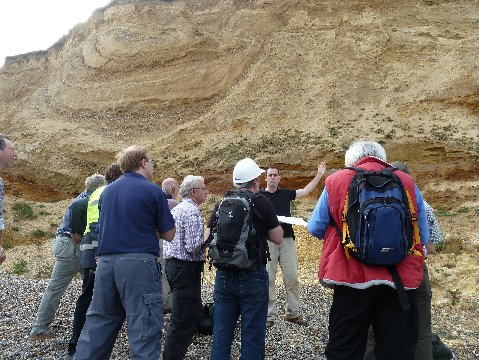 Ian Candy explains about the Wroxham (Weybourne) Crag and the dramatic overlying drift of the Anglian glaciation. (Photo: Russell Yeomans) Ian Candy explains about the Wroxham (Weybourne) Crag and the dramatic overlying drift of the Anglian glaciation. (Photo: Russell Yeomans)
10th September (Afternoon): Pre-Glacial and Glacial deposits of North Norfolk: Part 2, Sheringham to Weybourne:
Leaders: Dr Jonathan Lee and Dr Emrys Phillips (BGS)
This was a follow-up to the successful 2010 Field Excursion to West Runton. The trip examined: (1) Early Pleistocene shallow marine 'Crag' deposits; (2) the highly-deformed glacial succession which includes evidence for several ice-marginal oscillations of the Middle Pleistocene British Ice Sheet; (3) multiple episodes of periglacial activity; and (4) the geomorphology of ice-marginal retreat. Attendees were actively encouraged to examine the sections and put forward their own ideas.
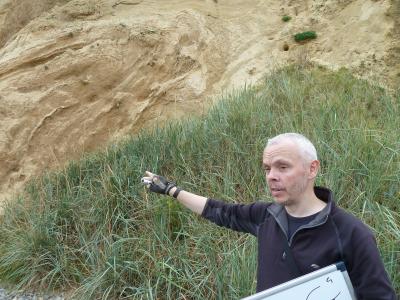 Emrys Phillps (BGS) interprets a recumbent fold in the till complex below Skelding Hill, Sheringham (Photo: Martin Warren) Emrys Phillps (BGS) interprets a recumbent fold in the till complex below Skelding Hill, Sheringham (Photo: Martin Warren)
|